

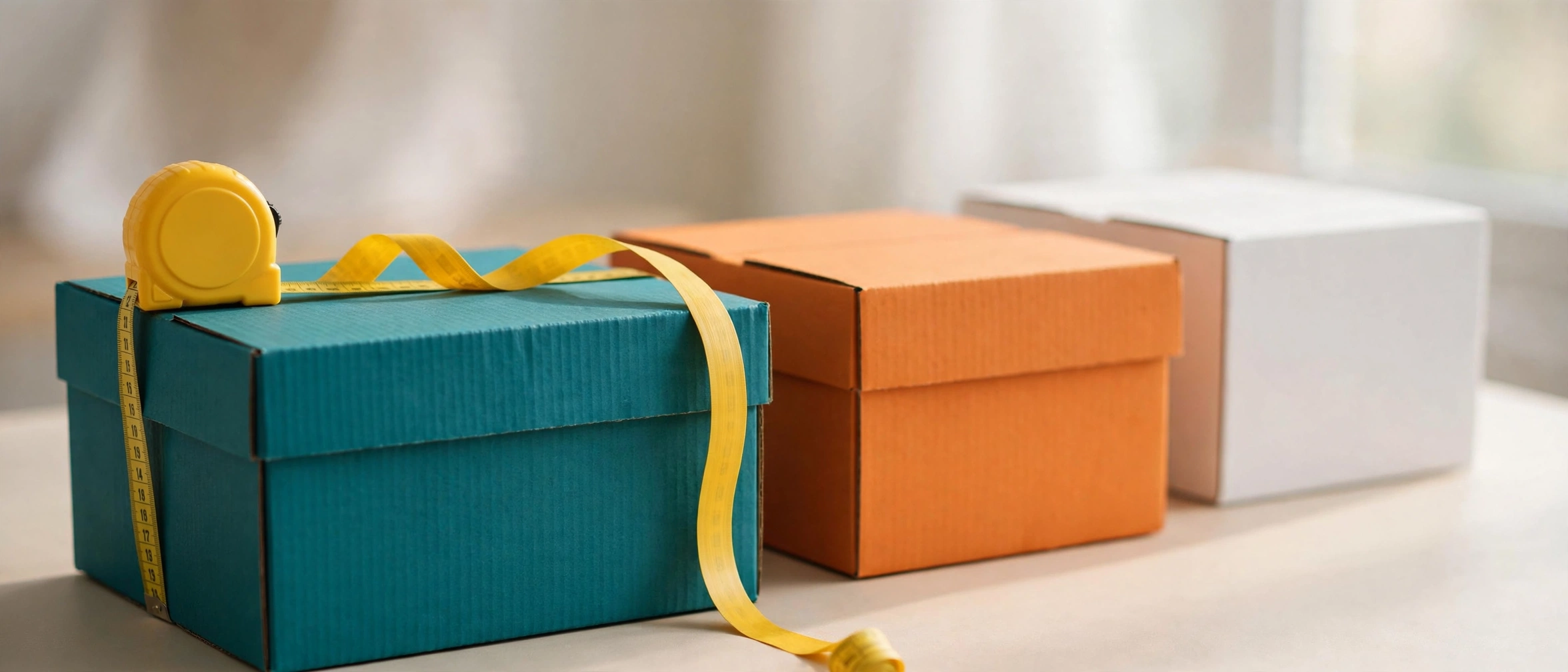
A box may look simple, but its dimensions influence how a product fits, how safely it travels, and how efficiently it can be stored. Measuring dimensions of a box correctly helps businesses avoid costly packaging mistakes when shipping products or ordering custom boxes.
Three measurements are typically referred to as a box’s dimensions: length, breadth, and height. But being aware of these measurements is just the beginning. The final packing decision is influenced by the type of box, the material used to make it the object being packed and the available interior space.
We will explain how to measure boxes, calculate their capacity, measure different box shapes and how to select the packaging for various shapes and sizes.
What Is the Dimension of a Box?
Box dimensions indicate the measurements of a package across three different directions. For most rectangular cartons, these measurements are recorded in the following order:

Length × Width × Height (L × W × H)
Each measurement serves a different purpose:
- Length: Usually the longer side of the box opening or base.
- Width: The other side of the opening, measured perpendicular to the length.
- Height: The distance from the bottom to the top of the box.
Consider a carton measuring 12 × 8 × 5 inches. This means the box is 12 inches long, 8 inches wide, and 5 inches high when measured according to the specified convention.
The order should remain consistent when sharing dimensions with a packaging supplier. For box styles that open from an end rather than the top, confirm the supplier’s measurement convention instead of assuming every carton is measured in the same orientation.
How to Measure a Box Accurately
Measuring dimensions of a box accurately starts with one decision: do you need the interior dimensions for product fit or the exterior dimensions for shipping and storage? Use a ruler or measuring tape, and place the box on a stable, flat surface.
Step 1: Measure the Length
Identify the longer side of the relevant opening or base. Position the measuring tool at one end and stretch it in a straight line to the other end.
For example, if the base measures 12 inches along its longer side, record the length as 12 inches.
Step 2: Measure the Width
Measure the side perpendicular to the length. If the shorter side of the same base is 8 inches, record the width as 8 inches.
A rectangular box, however, generally has different measurements for these two sides.
Step 3: Measure the Height
Measure vertically from the bottom to the top edge, including any lid if applicable. Always measure the assembled box to ensure accurate product fit.
Step 4: Record the Measurements Clearly
Write the results in the standard order and specify the unit. For example:
Internal dimensions: 12 × 8 × 5 inches
This format tells the supplier that the figures describe the usable space inside the carton. If the measurements are external, label them accordingly.
Internal Dimensions vs. External Dimensions
Boxes have internal and external measurements due to the thickness of their walls.
Internal dimensions describe the available space inside the assembled box. They are especially important when packaging products that need a close fit or must sit inside a particular insert.
External dimensions describe the overall size of the finished package. These measurements are useful for checking warehouse space, arranging cartons for transportation, and entering package details for shipping.
The difference between the two depends on the board thickness, construction, and box style. Corrugated packaging, for example, has a fluted structure between its liners, so the usable interior space is not identical to the outside size.
Suppose a glass bottle measures 9 inches in height. Selecting a box with an internal height of exactly 9 inches may leave insufficient room for a protective base or top insert. The correct packaging dimensions should account for these components before the box is manufactured.
Practical tip: When requesting custom packaging, provide the product’s measurements and explain how it will be protected. A packaging manufacturer can then help determine the appropriate finished box dimensions.
How to Calculate Box Volume
Box volume represents the total space inside a rectangular carton. It can help compare box sizes, estimate storage requirements, and plan how products will be arranged.
Use this formula:
Volume = Length × Width × Height
For a box measuring 12 × 8 × 5 inches:
12 × 8 × 5 = 480 cubic inches
The result is expressed in cubic inches because all three measurements use inches. Measurements in centimeters produce a volume in cubic centimeters (cm³).
Volume is useful when comparing two cartons, but it does not tell you whether a particular product will fit. Two boxes can have the same volume and very different shapes.
How to Measure Different Types of Boxes
Packaging dimensions vary according to the box’s shape and design.
Rectangular Shipping Boxes
Measure the length, width, and height, using internal or external dimensions as required.
Mailer Boxes
Measure the usable internal length, width, and depth. Account for any inserts that reduce the available space.
Folding Cartons
Folding cartons are frequently used for cosmetics, food products, retail items, and lightweight goods. Their dimensions depend on the panel arrangement and the way the carton opens.
A narrow carton designed for a bottle, for instance, may have a small opening and a much greater vertical dimension. Tell the manufacturer which end receives the product so the dimensions are interpreted correctly.
Round Boxes and Tubes
Round packaging is generally measured using its diameter and height.
Diameter × Height (D × H)
For example, a cylindrical container with a diameter of 4 inches and a height of 10 inches can be specified as 4 × 10 inches, provided the measurement order is clearly labelled.
Measure straight across the circular opening through its centre to determine the diameter. Avoid measuring around the circumference when the supplier needs the diameter.
Boxes for Irregularly Shaped Products
Items with handles, protruding parts, or unusual contours require extra attention. Measure the maximum length, width, and height of the product in the position in which it will be packed.
If the product cannot sit safely without a special insert, share its shape and packing requirements with the manufacturer. A simple rectangular measurement may not fully describe the space needed for a secure fit.
How to Size a Shipping Box for Multiple Products
When several retail packages must fit into one outer carton, plan the arrangement before choosing the shipping box. Simply multiplying the volume of one product box by the number of units will not provide the correct length, width, and height.
Imagine that each retail carton measures 6 × 5 × 5 inches and you need to ship 12 cartons.
One possible arrangement is:
- Two cartons along the length: 2 × 6 = 12 inches.
- Two cartons along the width: 2 × 5 = 10 inches.
- Three cartons stacked in height: 3 × 5 = 15 inches.
The products therefore occupy a rectangular arrangement measuring 12 × 10 × 15 inches, before adding any necessary clearance or protective materials.
The shipping carton must provide enough internal space for the arrangement, separators, cushioning, and any required packing clearance. Depending on the product and stacking method, another arrangement may use space more efficiently.
Before ordering a large quantity of cartons, test the proposed layout using actual products or sample packages. This can reveal gaps, movement, or loading difficulties that a volume calculation alone will miss.
Common Box Measurement Mistakes
Incorrect measurements can cause products to fit poorly, packaging orders to be delayed, or shipping estimates to be inaccurate. Avoid these common errors:
- Mixing up the measurement order: Label length, width, and height rather than sending three unexplained numbers.
- Ignoring wall thickness: Internal space is smaller than the exterior footprint and dimensions suggest.
- Forgetting protective inserts: Foam, dividers, and cardboard supports occupy usable space.
- Measuring only one product surface: Include handles, caps, attachments, and other parts that affect the packed size.
- Using inconsistent units: Specify inches, centimetres, or millimetres and use them consistently.
- Guessing the clearance: The amount of additional room depends on the product, cushioning, and packaging design.
- Approving production without checking a sample: A physical test can identify sizing problems before a full order is manufactured.
Choosing the Right Dimensions for Custom Packaging
The best box size depends on the product and its intended use. Retail packaging may need a precise fit and attractive presentation, while shipping cartons may require additional room for protective materials and safe handling.
When requesting a custom box quotation, prepare the following information:
- Product length, width, and height.
- Required internal dimensions, if already established.
- Product weight and quantity per carton.
- Insert, divider, or cushioning requirements.
- Preferred box style and material.
- Printing, branding, and finishing requirements.
- Shipping, storage, or display considerations.
If the dimensions are uncertain, ask the packaging supplier to review the product specifications. A sample box or prototype can help confirm that the product fits and the packaging closes properly before the final production run.
Frequently Asked Questions
What is the standard order for box dimensions?
Rectangular boxes are commonly specified as length × width × height. Some packaging styles use depth instead of height, and conventions can vary, so confirm the supplier’s preferred format.
Should box dimensions be measured from the inside or outside?
Use internal dimensions when determining product fit and usable space. External dimensions are important when evaluating the package’s overall size for shipping, storage, and handling.
How much extra space should a box have?
There is no single clearance that works for every product. The required space depends on the product’s shape, fragility, packing method, and protective materials. Test the complete packed arrangement rather than adding an arbitrary amount.
Can two boxes with identical volume have different dimensions?
Yes. Volume describes the total three-dimensional space, not the proportions of the box. A long, narrow carton and a short, wide carton can have the same volume while accommodating very different products.
Conclusion
Mastering measuring dimensions of a box helps businesses select packaging that fits products properly, uses space efficiently, and supports reliable shipping. Accurate sizing involves more than measuring three sides: it also requires understanding the box style, separating internal from external measurements, and accounting for inserts and protective materials.
Before placing a custom packaging order, document the required dimensions, explain how the product will be packed, and verify the design with a sample when possible. These steps help turn basic measurements into a packaging solution that works for the product and the business.