

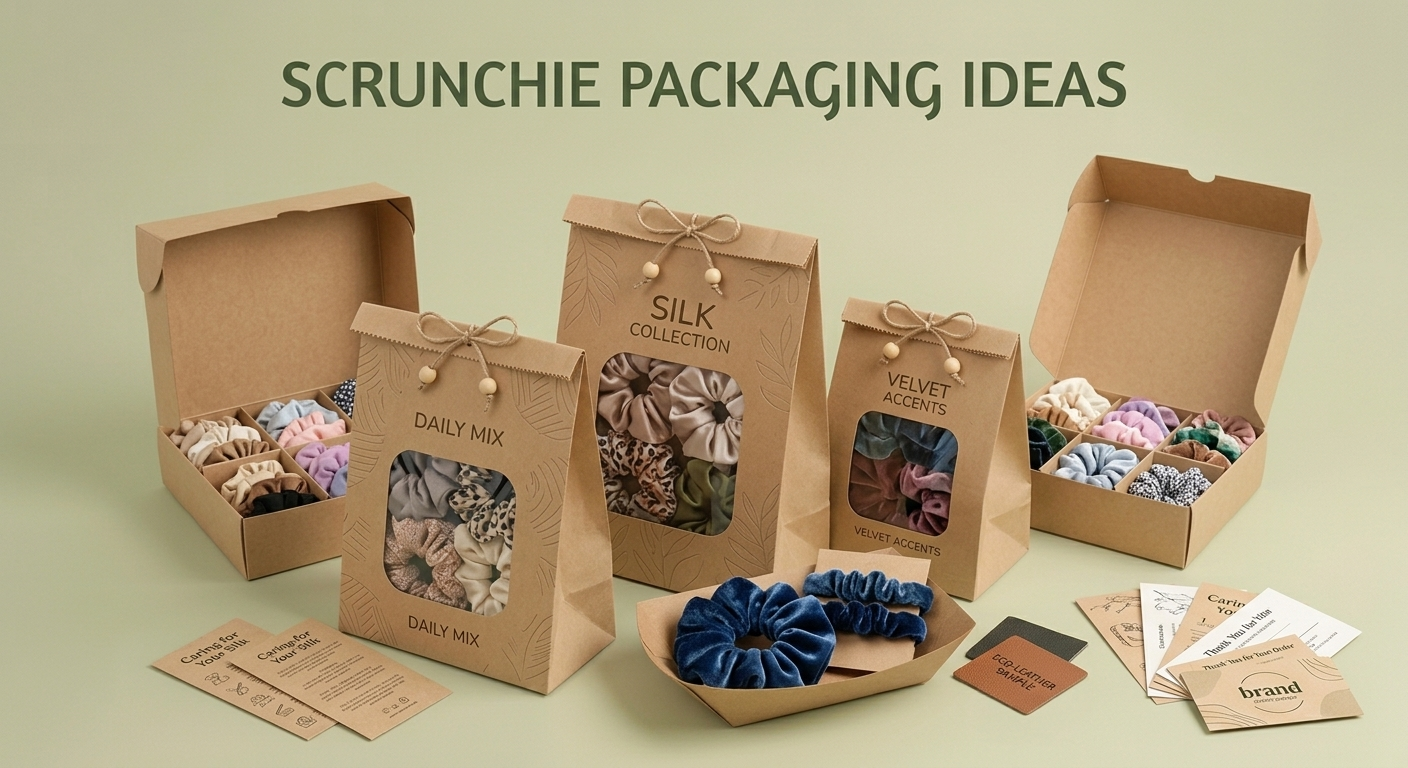
Good scrunchie packaging should do more than hold a hair accessory. It should keep the product clean, make the color and fabric easy to appreciate, communicate the brand clearly, and suit the way the scrunchie will be sold.
For a small handmade business, a printed display card may be enough. A premium silk scrunchie collection may benefit from a rigid gift box or fabric pouch. Retail stores may need hangable packaging, while ecommerce sellers should also think about shipping weight and protection.

Here are 15 scrunchie packaging ideas that can work across different budgets and brand styles.
1. Branded Scrunchie Display Cards
Display cards are one of the simplest scrunchie packaging ideas. The scrunchie wraps around or attaches to a printed paperboard card that can carry your logo, product name, care information, website, or social handle.
They work particularly well for boutiques, craft fairs, and retail peg displays.
Best for:
- Single scrunchies
- Small businesses
- Low-cost retail packaging
- Products that need to remain visible
Use thicker card stock if the scrunchie is heavy or made from dense velvet.
2. Paper Belly Bands
A paper belly band or sleeve wraps around the center of the scrunchie. It uses less material than a full box and still gives you space for branding.
This option works well when the fabric itself is attractive enough to be the main visual.
Keep the band snug enough to stay in place without crushing the scrunchie.
3. Kraft Paper Cards
Kraft paper creates a natural, handmade look that suits cotton, linen, neutral, organic-style, or craft-focused collections.
A simple black logo can work well on kraft, but brands can also use one or two accent colors to distinguish product lines.
Kraft cards are especially useful for brands that want packaging with a less glossy visual style.
4. Window Boxes
A paperboard box with a die-cut window combines protection with product visibility. Customers can see the scrunchie’s color and texture while the box keeps it contained.
Window boxes are useful for premium retail, gift collections, and multi-piece sets.
5. Pillow Boxes
Pillow boxes have curved sides and a compact shape that suits lightweight accessories. They can hold one or several scrunchies depending on their dimensions.
Printed pillow boxes can include a logo, pattern, product details, and finishing. They are also relatively easy to store flat before assembly.
6. Small Tuck Boxes
A straight tuck or reverse tuck carton provides more structure than a card or band. It gives the brand several printable panels for product information and design.
Tuck boxes work well for ecommerce and retail when the product needs a cleaner, more enclosed presentation.
For multiple scrunchies, adjust the box dimensions so the products sit comfortably without being compressed.
7. Rigid Gift Boxes
Rigid boxes are better suited to premium scrunchies, silk collections, bridal sets, influencer gifts, and special editions.
The stronger construction makes the product feel more gift-ready. A rigid box can also include tissue, an insert, a ribbon pull, or a printed message inside the lid.
Because rigid packaging costs more and takes more shipping space, it makes the most sense when the product price supports the presentation.
8. Drawer Boxes
A drawer or sleeve-and-tray box creates a more deliberate unboxing experience. The outer sleeve can carry the main branding while the inner tray presents the scrunchies neatly.
This format works well for sets of three, five, or more scrunchies, especially when colors are arranged as a collection.
9. Fabric Drawstring Pouches
A reusable fabric pouch can make scrunchie packaging feel more personal. Cotton, satin, velvet, or similar materials can be selected to match the product positioning.
The pouch can also become storage for the scrunchies after purchase, which gives the packaging a second use.
This option is particularly suitable for silk or premium hair accessories.
10. Glassine or Paper Bags
Small glassine or paper bags offer a lightweight solution for ecommerce orders, handmade sellers, and lower-cost collections.
They can be closed with a branded sticker and paired with a small thank-you or care card.
This format is compact, which can help reduce unnecessary shipping volume compared with larger boxes.
11. Clear Boxes
A clear box makes the product fully visible while protecting it from handling and dust. It can be useful for colorful scrunchies, gift sets, and retail displays.
If reducing plastic is part of your brand positioning, compare transparent material options carefully and avoid making sustainability claims that your material choice cannot support.
12. Hang Tags
A small printed hang tag can be attached to the scrunchie with string, ribbon, or another suitable fastener.
Hang tags use very little packaging material and work well when the product will be displayed in baskets, on hooks, or as part of a handmade collection.
Include only the information that matters. A small tag becomes difficult to read when overloaded with text.
13. Multi-Pack Boxes With Inserts
If you sell scrunchie sets, a box with an insert or divider can keep each piece in a defined position.
This is useful when the collection is organized by color, fabric, season, or theme. An insert also prevents the products from shifting around before the customer opens the package.
Paperboard inserts are often sufficient for lightweight hair accessories.
14. Mini Gift Bags
Small paper gift bags are useful for boutiques, markets, event favors, and gift purchases. Add a logo sticker, printed handle tag, tissue paper, or branded card to make a standard bag feel more intentional.
Mini bags are also convenient when customers buy several individual scrunchies and want them packaged together.
15. Subscription Packaging
A scrunchie subscription needs packaging that can change without losing the brand identity. Use a consistent outer mailer or box, then vary tissue, cards, stickers, colors, or printed inserts by month or season.
The package should protect the products during delivery while still creating a pleasant reveal when opened.
How to Choose the Best Scrunchie Packaging
Start With the Sales Channel
Packaging for a boutique shelf has different requirements from packaging for an online order.
Retail packaging may need a hang hole, barcode area, strong front branding, and product visibility. Ecommerce packaging should prioritize shipping efficiency, protection, and an attractive unboxing experience without creating unnecessary weight.
Match Packaging to Product Value
A low-cost everyday scrunchie may not need a rigid box. A premium silk set may look under-presented on a basic card.
Packaging cost should make sense in relation to the product price, margin, and customer expectation.
Protect the Fabric
Scrunchies can collect dust, pick up odors, become flattened, or snag on rough surfaces. Delicate silk and satin products need more careful handling than some basic cotton styles.
Choose packaging that protects the product without compressing it for long periods.
Leave Space for Branding
Even simple packaging should identify the brand. Useful elements can include:
- Logo
- Website
- Social media handle
- Material or fabric information
- Care instructions
- Barcode or SKU
- Country-of-origin information where required
- Short brand message
Do not fill every available area. Hair accessories are visual products, so giving the product room to be seen can be more effective than adding extra copy.
Scrunchie Packaging Ideas by Business Type
For Handmade Sellers
Start with display cards, kraft cards, belly bands, glassine bags, or simple hang tags. These options are practical for smaller quantities and allow the handmade product to remain visible.
For Boutique Brands
Consider window boxes, tuck boxes, drawer boxes, or well-designed display cards. Consistent typography and color can make a small product range look more organized.
For Luxury Scrunchie Brands
Rigid boxes, drawer boxes, fabric pouches, foil details, embossed logos, and carefully designed inserts can support a premium position.
For Gift Sets
Use multi-pack boxes, rigid boxes, drawer packaging, or mini gift bags. Arrange the scrunchies by color or fabric so the set looks intentional when opened.
Scrunchie Packaging Design Checklist
Before ordering packaging, check:
- Measure the scrunchie in its natural shape.
- Test whether the package compresses the fabric.
- Confirm the number of scrunchies per pack.
- Decide whether customers should see the product before opening.
- Leave enough space for the logo and required information.
- Check barcode dimensions if selling through retail.
- Test the packaging on hooks or shelves if needed.
- Pack and ship a sample before ordering a large quantity.
- Check whether finishes rub against delicate fabric.
- Compare packaging cost with product margin.
- Review recycling or disposal instructions before making environmental claims.
How to Make Scrunchie Packaging Look More Professional
Use Consistent Branding
Use the same logo treatment, typography, colors, and tone across cards, boxes, stickers, thank-you cards, and shipping materials.
Improve the Product Arrangement
Presentation matters even inside a small box. Keep scrunchies centered, evenly spaced, and arranged by color. For sets, an insert can make a major visual difference.
Add Useful Information
Care instructions are more valuable than filler text. Tell customers how to store, wash, or handle the fabric when the material requires special care.
Test Before Buying in Bulk
Order a prototype or sample whenever possible. Put the real scrunchie inside, close the package, store it, handle it, and ship it to yourself. A design that looks good on a screen can behave differently once the product is packed.
Frequently Asked Questions
What is the cheapest way to package scrunchies?
Printed cards, belly bands, hang tags, and simple paper or glassine bags are usually among the most economical formats because they use less material and take up little space.
What packaging is best for silk scrunchies?
Silk scrunchies benefit from packaging that reduces snagging, dust, and compression. Fabric pouches, smooth paperboard boxes, drawer boxes, or rigid gift boxes can work well depending on the price point.
How do you package scrunchies for retail?
Use packaging that displays the product clearly and fits the retailer’s merchandising system. Display cards with hang holes, window boxes, and compact tuck boxes are common options. Leave room for a barcode, SKU, and required product information.
Can I package several scrunchies together?
Yes. Multi-pack cartons, drawer boxes, rigid boxes, and display cards can hold several scrunchies. Inserts or dividers can keep a premium set organized.
What should I put on scrunchie packaging?
Include your brand name or logo and any useful product information. Depending on the sales channel, you may also need material details, care instructions, barcode, SKU, website, social handle, or other required labeling.
Final Thoughts
The best scrunchie packaging ideas balance presentation, protection, cost, and convenience. A small handmade seller may get excellent results from a well-designed card, while a premium silk collection may justify a rigid box or reusable pouch.
Choose the packaging around the product and sales channel first. Then use branding, print, color, and finishing to make the final presentation distinctive without adding unnecessary material or cost.